Why Most Aluminum Welding Fails — And How We Fix It Right the First Time
Serving Maryland, Delaware & the Eastern Shore — Mobile Welding, Repairs & Fabrication from Cecil County to Wilmington, DE
THE TRAP
Most welding shops reach for the same wire on every aluminum job. It's called 4043, and in the right situation it works fine. The problem is — most shops use it in every situation. Wrong alloy. Wrong application. Wrong result. Welds that crack, leak, corrode, or fail under load.
At PIE LLC Weld & Machine, we've spent decades understanding what aluminum actually needs. That means knowing when 4043 is right — and knowing the four other filler wires that outperform it when it isn't.
That's the 4043 Trap. And we're the shop that doesn't fall into it.
4043 is the wire most welding shops reach for on every aluminum job. And in the right situation it works perfectly well. It flows clean, it's forgiving to weld, and for general fabrication on 6000 series aluminum it does exactly what it needs to do. The problem isn't 4043 itself — it's the shops that use it on everything regardless of the application. Wrong wire, wrong job, wrong result. At PIE LLC Weld & Machine we know when 4043 is the right call. We also know when it isn't.
4043 — The Industry Default. Good When Used Right. Overused When Not.
If your boat lives in saltwater, 5356 is the wire that belongs on it. It is the most widely used aluminum filler wire in marine applications for good reason — it delivers superior corrosion resistance, excellent strength and stands up to the punishment of constant salt water exposure. Skegs, transoms, railings, fuel tanks, hull repairs — if it goes in the water, 5356 is our first choice. It is exactly the wire we used when we rebuilt a cracked aluminum boat transom, restoring a saltwater-damaged hull back to full strength. We do aluminum boat repairs across the Chesapeake Bay region, the Eastern Shore of Maryland, Cecil County and into Delaware. If salt water is in the equation, we know exactly what your aluminum needs.
5356 — The Marine King. Saltwater. Corrosion. Strength.
When the job calls for higher yield strength or you are dealing with contaminated or dirty castings, 4943 is the wire that delivers. It outperforms 4043 in strength, handles the impurities common in cast aluminum, and is our go-to choice for marine engine parts, gearbox housings and components where weld failure is not an option. If your repair involves an aluminum casting that has seen oil, salt or years of heat cycles, this is the wire that gets it done right — the same wire we reached for when we repaired a cracked cast aluminum Cub Cadet engine, sealing an oil drain port that had failed at the threads. Serving Cecil County, the Eastern Shore and Delaware, we handle castings other shops turn away.
4943 — High Strength. Dirty Castings. Built for Demanding Work.
4047 is the specialist wire that most shops have never even loaded in their machine. With a higher silicon content than standard wires it flows into thin sections beautifully, reduces the risk of cracking and is the correct choice for 6000 series aluminum radiators where center cracking is a common failure point. If you have brought a cracked radiator or a thin walled aluminum component somewhere else and had it fail again, there is a good chance the wrong wire was used. We use 4047 where the job demands it — and we know the difference. Mobile aluminum repair available throughout Maryland, Delaware and the tri-state area.
4047 — Thin Sections. Castings. Stopping Cracks Before They Start.
For heavy structural marine fabrication where load bearing strength and long term corrosion resistance are both critical, 5183 is the wire the job demands. It delivers higher tensile strength than 5356 and is the correct choice for structural components on commercial vessels, large boat frameworks and any marine application where the weld has to hold under serious load in a saltwater environment. This is specialist territory and it is work we do regularly across the Chesapeake Bay region, the Eastern Shore and into Delaware. When the structure has to hold, we use the wire that was built for it.
5183 — Heavy Structural Marine. When Strength is Non-Negotiable.
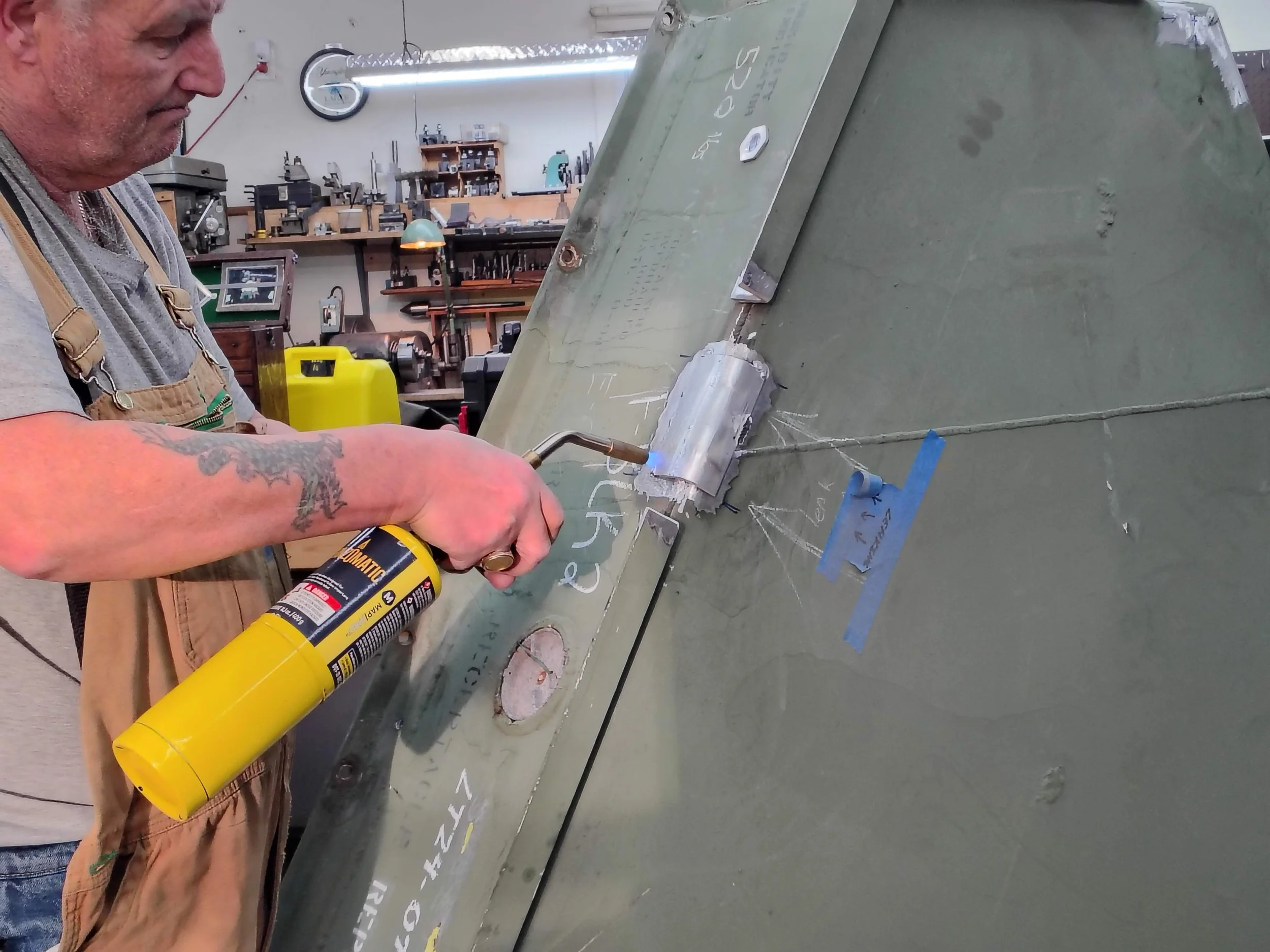
6061 aluminum military container — Boeing CH47 Chinook helicopter part. Preheating before repair. This is a 4047 application. Better flow, crack resistance and built to handle the punishment of worldwide military transit.
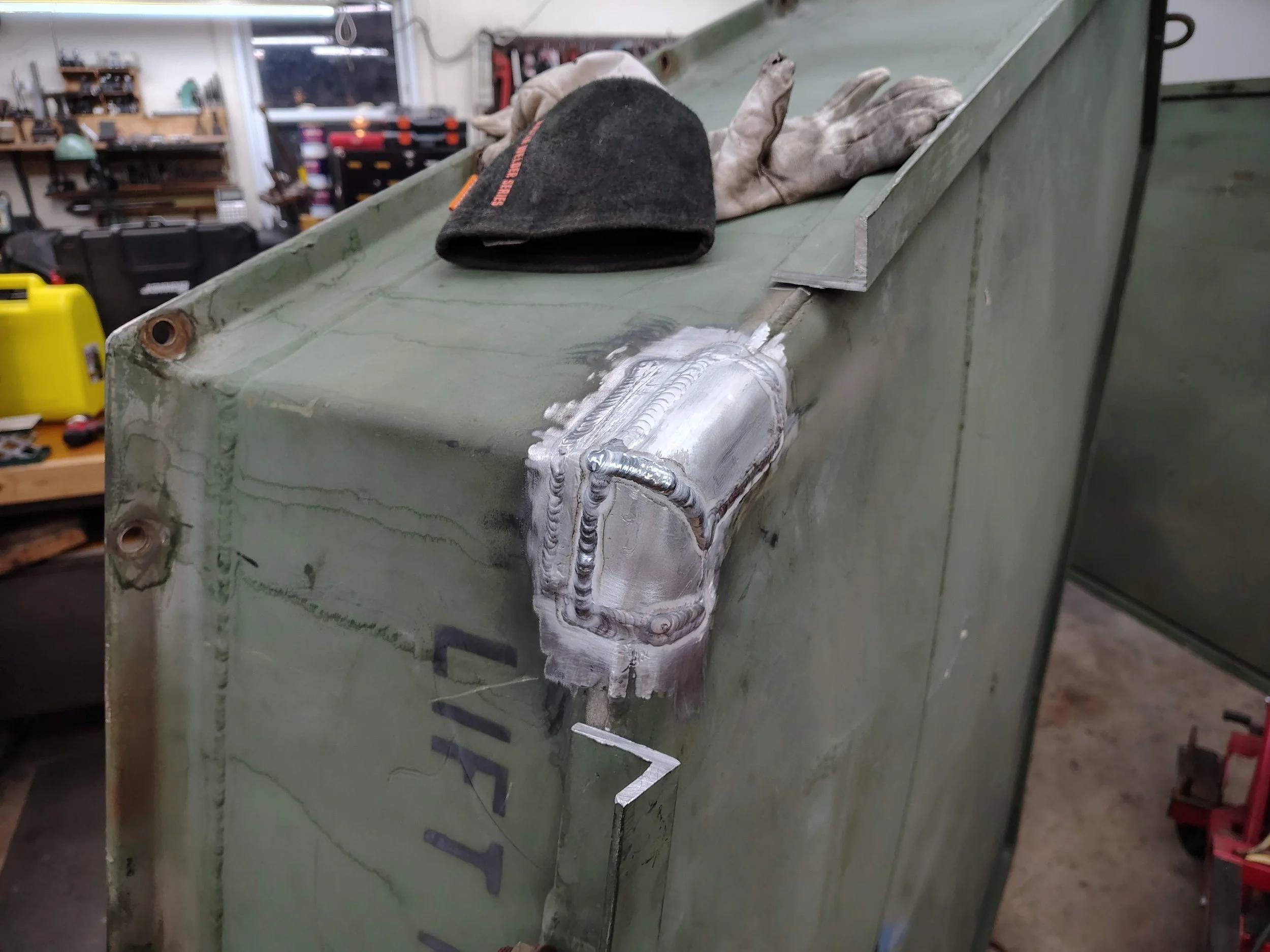
Completed weld repair on a nitrogen pressurized CH47 helicopter part container. 6061 base material, 4047 filler wire. The weld has to hold — these containers travel the world.
Most welding shops prefer new fabrication work. Clean metal, controlled conditions, straightforward jobs. Repairs are a different story — contaminated metal, unknown alloys, previous weld failures, awkward shapes and components that have been stressed, corroded or cracked over years of hard use. That is exactly the kind of work we take on.
At PIE LLC Weld & Machine repair work is not something we do on the side. It is a core part of what we do and we have built a reputation for taking on the jobs other shops turn away. If you have been told it can't be fixed — call us before you write it off.
We repair aluminum across a wide range of applications:
Trailers and frames, Jeep and off road components, garden and outdoor equipment, automotive parts including radiators and intake components, aviation ground support equipment, industrial housings and brackets, prototype and custom fabricated parts, and general aluminum repairs of all kinds across Cecil County, Maryland, Delaware and the surrounding tri-state area.
Had it repaired somewhere else and it failed again?
That is one of the most common calls we get. A previous repair that cracked, leaked or failed under load almost always comes down to the wrong filler wire or inadequate prep. We will assess it honestly and tell you exactly what went wrong and what it will take to fix it properly.
We also come to you. If it can't be trailered or driven in, our mobile welding service covers Maryland, Delaware and the Eastern Shore. No shop visit required.
Aluminum Repair — We Fix What Others Won't Touch.
Saltwater is one of the most punishing environments aluminum can face. Fatigue, corrosion, stress cracking, impact damage, every aluminum boat deals with these issues over time. Marine aluminum repair is a specialty within a specialty and it deserves its own conversation.
We have dedicated an entire page to aluminum welding and repair in the marine environment covering why aluminum cracks and fatigues on the water, what the repair options are, and why filler wire choice is critical when your boat lives in salt water.
If you own a boat and you have an aluminum repair issue — read this page before you call anyone.
Boat Owner? We Have an Entire Page Dedicated to You.
Ready to Get It Fixed Right?
Whether you have a repair that has already failed once, a build that needs to be done properly, or an aluminum project you need quoted — we are ready to help. We serve Maryland, Delaware and the Eastern Shore. We also come to you.
-
The most common cause is the wrong filler wire for the alloy being welded. 4043 is the default wire most shops use but it is not suitable for every aluminum alloy or application. High stress joints, 7000 series aluminum and certain castings require a different wire entirely. The second most common cause is inadequate preparation — aluminum oxidizes instantly and that oxide layer must be properly removed before welding. If your weld has cracked more than once the diagnosis starts with wire selection and prep.
-
Yes — but not by every shop. Cast aluminum is notoriously difficult to weld because of its porosity, contamination from years of oil and heat cycles and unpredictable alloy composition. At PIE LLC Weld & Machine cast aluminum repair is a specialty. We use 4943 filler wire specifically developed for dirty castings and high strength applications. If you have been told your casting cannot be repaired call us before you write it off.
-
4043 is a general purpose wire suited to 6000 series aluminum fabrication. It flows well and is forgiving to weld but has lower strength and poor corrosion resistance in saltwater. 5356 is the correct choice for marine applications — it delivers superior corrosion resistance, higher strength and stands up to constant saltwater exposure. Using 4043 on a saltwater application is one of the most common mistakes we see from shops that do not specialize in aluminum.
-
Yes. We repair aluminum pontoons, floats and flotation devices of all types. We also perform air and hydro testing on any pontoon or float with a manufactured port of entry — which most aluminum pontoons have as standard. If your pontoon is leaking, cracked or has sustained impact damage we can assess, repair and test it. We serve boat owners across the Chesapeake Bay region, the Eastern Shore of Maryland, Cecil County and into Delaware.
-
Yes. If your boat, trailer, equipment or vehicle cannot be brought to us we will come to you. Mobile aluminum welding is available throughout Maryland, Delaware and the Eastern Shore. We carry the equipment to handle most aluminum repair work on site. Call us to discuss your specific situation and we will tell you honestly whether a mobile repair is the right solution.
-
The signs usually show up over time rather than immediately. Cracking along the weld line, corrosion concentrated at the weld, leaks returning after a previous repair, or weld failure under normal load are all indicators that the wrong filler wire or process was used. If any of these apply to a repair you have already had done elsewhere bring it to us. We will assess it honestly and tell you exactly what went wrong.
Frequently Asked Questions — Aluminum Welding & Repair
Still Have Questions? Let's Talk.
Whether you are ready to book a repair, need a quote on a fabrication project, or just want to talk through what you need — we are easy to reach. No call centres, no automated systems. You call or email PIE LLC Weld & Machine and you get Tony.